The ghosts of Hampton Court Palace: the Haunted Gallery and other stories
A queen running for her life, a nurse at her spinning wheel and a figure caught on CCTV: the ghost stories of Hampton Court, and the history behind them.
Five centuries of royal births, deaths, scandals and executions have left Hampton Court with more ghost stories than perhaps any other royal palace. Staff and visitors have reported cold spots, unexplained screams and figures in Tudor dress for generations. Whether or not you believe in ghosts, the stories are a window onto real events: two of Henry VIII’s queens, a royal nurse and the soldiers of the Civil War. These are the best-known tales, and the history behind each one.
Catherine Howard and the Haunted Gallery
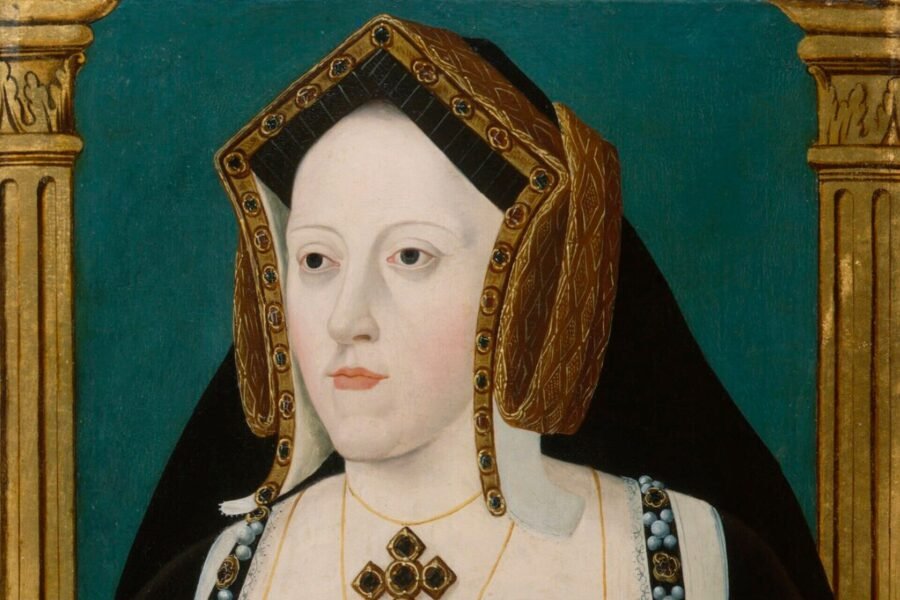
Catherine Howard, Henry VIII’s fifth wife, was probably still a teenager when she married the king in 1540. Within eighteen months she was accused of adultery. She was arrested at Hampton Court in November 1541 and beheaded at the Tower of London in February 1542.
The legend says that when she heard she was to be arrested, Catherine broke free from her guards and ran along the gallery towards the Chapel Royal, where Henry was hearing Mass, screaming for him to spare her. The guards dragged her back before she reached him. Ever since, a woman in white is said to run along the same corridor, screaming, and the passage is known as the Haunted Gallery.
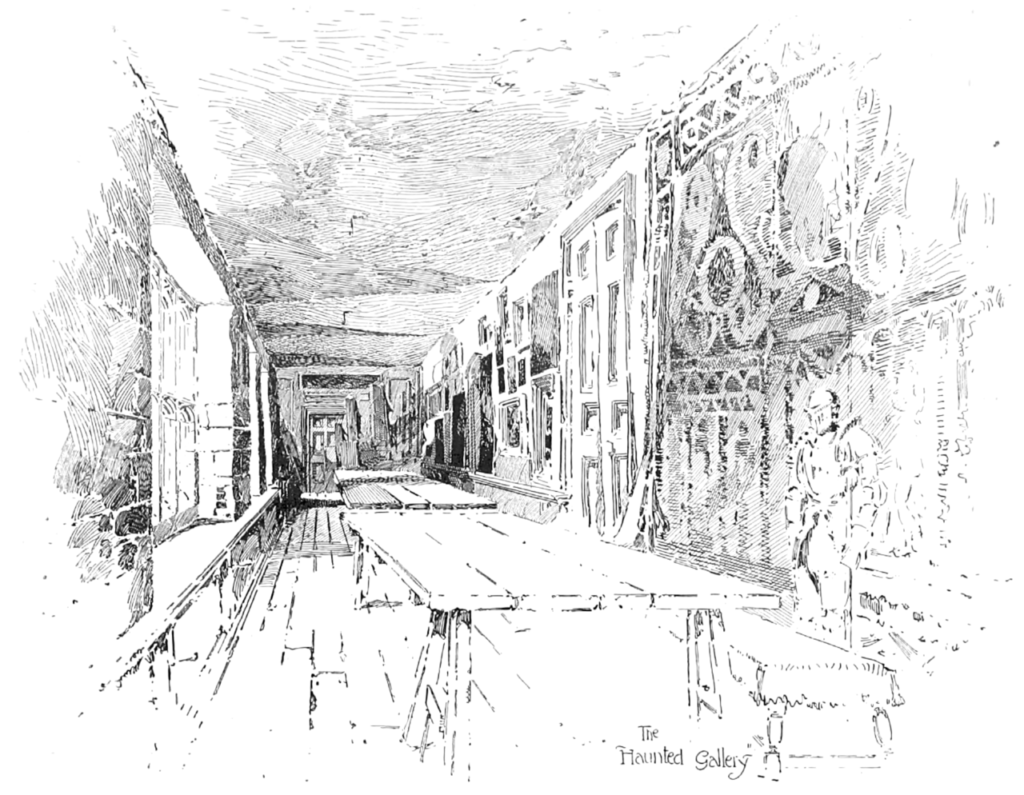
Historians are doubtful. No contemporary source records the dramatic dash, and the story seems to have appeared centuries later. But the gallery is real, and you walk along it on the palace route, between the state apartments and the Royal Pew. An early twentieth-century postcard even claimed to show Catherine’s ghost in the nearby Horn Room. It turned out to be a double exposure.
Jane Seymour on the Silverstick Stairs
Jane Seymour, Henry’s third wife, gave him what he wanted most: a son. Prince Edward was born at Hampton Court on 12 October 1537. Jane died less than two weeks later, probably of an infection after the birth.
Her ghost is said to appear on the anniversary of Edward’s birth, a pale woman carrying a lighted taper on the Silverstick Stairs, which led to the room where she gave birth. Of all the palace ghosts she is the gentlest: she isn’t screaming or pleading, only walking quietly towards the room where her son was born.
Sybil Penn, the Grey Lady
Sybil Penn served four Tudor monarchs. She was nurse to the young Edward VI, and later looked after Elizabeth I when she caught smallpox at Hampton Court in 1562. Elizabeth recovered, but Sybil caught the disease and died. She was buried in the church of St Mary at Hampton, just up the road.
For almost three centuries she rested quietly. Then, in 1829, the old church was rebuilt and her tomb was disturbed. Soon afterwards a tall, thin figure in a grey robe was seen in the palace’s state apartments and around Clock Court. In one of the grace and favour apartments, where the Crown housed widows and families of distinguished servants, residents complained of the whirr of a spinning wheel coming from behind a wall. According to the legend, when the wall was opened up, workmen found a forgotten room with an old, much-used spinning wheel inside.
The skeletons of Fountain Court
This is the story with the most solid evidence. In the nineteenth century an elderly grace and favour resident near Fountain Court complained of constant knocking and banging in the night. In 1871, during routine work, two male skeletons were found in shallow graves beneath the cloister. Once they were given a proper burial, the noises stopped.
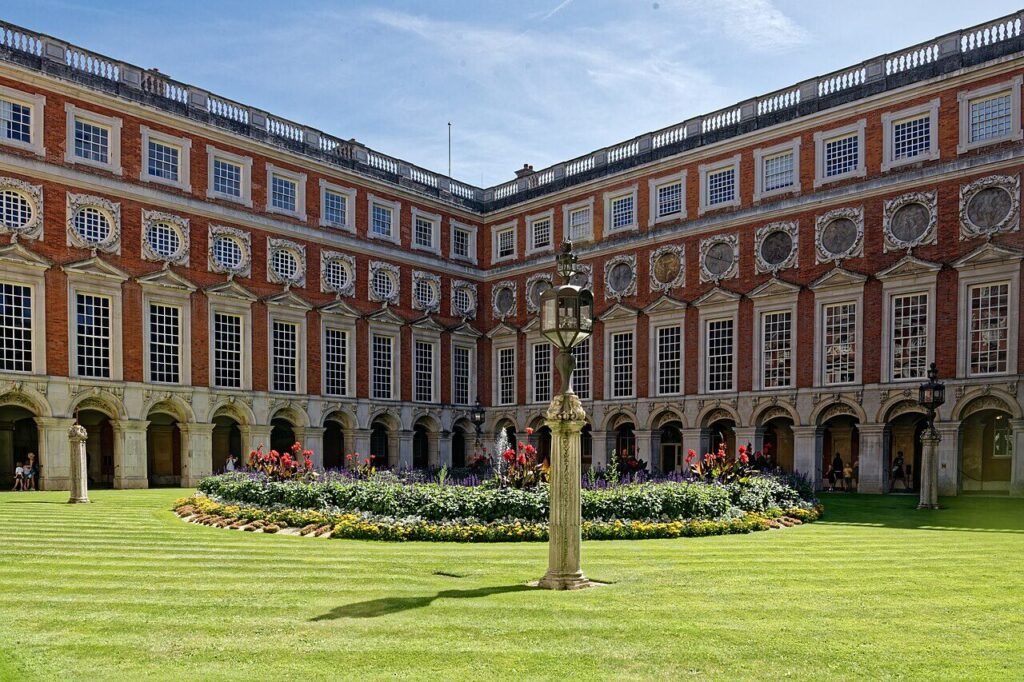
Who were they? One theory is that they were soldiers killed in the Civil Wars of the 1640s, when Hampton Court was first Charles I’s prison and later Oliver Cromwell’s country house. They may have been buried quickly and then built over when Christopher Wren put up Fountain Court in the 1690s.
The figure on CCTV
The most famous modern sighting came in October 2003. On three days in a row, security staff found a heavy fire door off Clock Court flung open, and on the second day the palace’s CCTV recorded something. A figure in what looks like a long, old-fashioned robe appears in the doorway, at the doors, with a strangely pale face. The footage went round the world that Christmas.
The palace never found an explanation. No member of staff recognised the figure, and nobody ever owned up to a prank, though plenty of sceptics have suggested a visitor in costume. More than twenty years later, the fire door still fascinates ghost hunters.
Why Hampton Court has so many ghosts
There’s a good historical reason the palace collected so many stories. After George II, no monarch lived at Hampton Court again. From the 1760s the Crown divided its rooms into “grace and favour” apartments, given rent-free to widows and families of people who had served the country. For nearly two centuries the palace was home to dozens of households, many of them elderly ladies living in long, draughty corridors of a building that creaked, groaned and echoed at night.
The Victorians loved a ghost story, and the residents swapped theirs over tea. Writers collected them, guidebooks repeated them, and every unexplained sound found a Tudor explanation. Many of the tales we tell today were first written down in the nineteenth century, long after the events they describe. That doesn’t make them less fun, but it does explain why they map so neatly onto the most famous names in the palace’s history.
The sightings haven’t stopped. In 2015 a twelve-year-old visitor took a photo on her phone in one of the palace rooms that seemed to show a tall, pale figure in a doorway. It made the national newspapers, and the debate about what it showed was never settled.
What the scientists found
In 2000 the psychologist Richard Wiseman ran one of the largest ghost experiments ever held, at Hampton Court. Hundreds of visitors walked through the Haunted Gallery and the Georgian rooms and recorded any unusual sensations. Believers reported more strange experiences than sceptics, as you might expect. But many people of both kinds reported feeling a sudden drop in temperature or a sense of a presence in the same parts of the Haunted Gallery. Wiseman suggested that draughts, changes in light and the visitors’ own expectations could explain much of it. A year earlier, in 1999, two women on separate tours had fainted at the same spot in the gallery on the same day.
Ghost hunting at Hampton Court
You don’t need a special ticket to walk the Haunted Gallery: it’s on the route through Henry VIII’s apartments, included in a standard palace ticket. Go late on a winter afternoon, when the light is fading and the crowds have thinned, and stand quietly at the far end near the Royal Pew.
- Ghost tours: the palace runs evening ghost tours at certain times of year, especially around Halloween and in winter. They sell out quickly and are ticketed separately.
- Halloween: autumn half-term often brings family trails and storytelling.
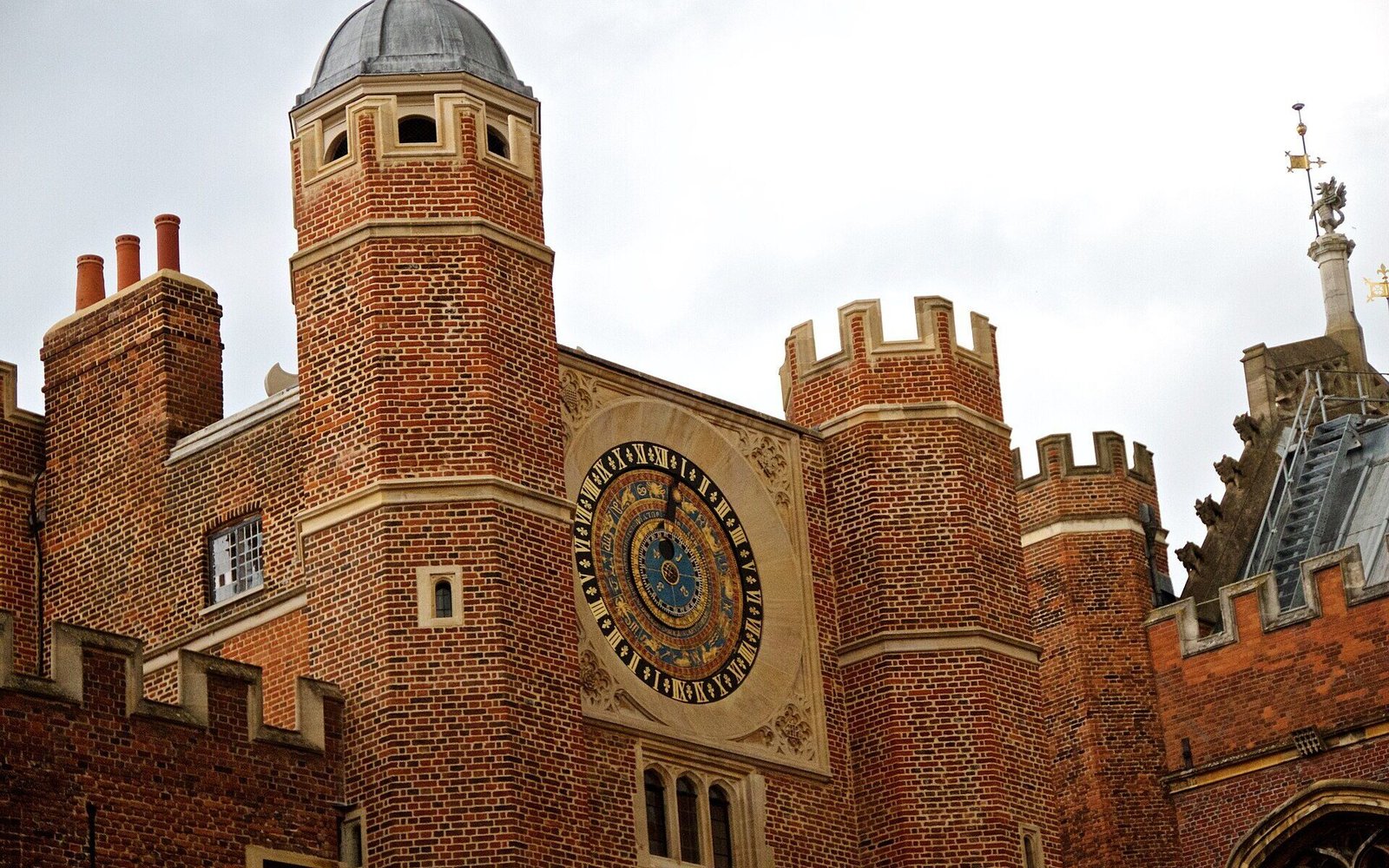
- Clock Court: you’ll pass through it on your way in, under Anne Boleyn’s Gate and the astronomical clock made for Henry VIII in 1540.
Want the real history behind the legends? Start with our series on Henry VIII’s six wives, or book a guided tour of the palace, where a good guide will happily tell you which stories they believe.
Questions people ask
Is Hampton Court Palace haunted?
It is often called the most haunted royal palace in Britain. The best known are Catherine Howard in the Haunted Gallery, Jane Seymour on the Silverstick Stairs and Sybil Penn, the Grey Lady. Whether they are real is up to you.
What is the Haunted Gallery?
A gallery in Henry VIII’s apartments, leading towards the Chapel Royal. Legend says Catherine Howard ran along it in 1541, begging the king for mercy. It’s on the palace route today.
What did the Hampton Court CCTV show?
In October 2003, after a fire door off Clock Court kept flying open, cameras recorded a pale figure in a long robe in the doorway. No explanation was ever found.
Some links on this page earn us a commission at no extra cost to you. How this site makes money