Home Park, Hampton Court: the deer, the Long Water and the best walks
Home Park is 750 acres of free, ancient parkland behind Hampton Court Palace, with deer, veteran trees and Charles II’s canal. When to go and what to see.
Most visitors to Hampton Court never leave the palace gardens. Just beyond them lies Home Park, 750 acres of ancient parkland with a herd of wild-living deer, avenues of lime trees, a canal dug for Charles II and wide views over open grassland. It’s free, it’s open from early morning until the evening, and on a weekday you can walk for an hour and see more deer than people. This guide covers when to go, what to look for, and how Home Park differs from Bushy Park across the road.
What and where is Home Park?
Home Park, also called Hampton Court Park, fills the great loop of the River Thames to the east of Hampton Court Palace, between the palace, Kingston and Thames Ditton. It covers about 750 acres. It’s owned by the Crown, managed by Historic Royal Palaces and protected as a Site of Special Scientific Interest for its rare grassland, veteran trees and the insects that live in them.
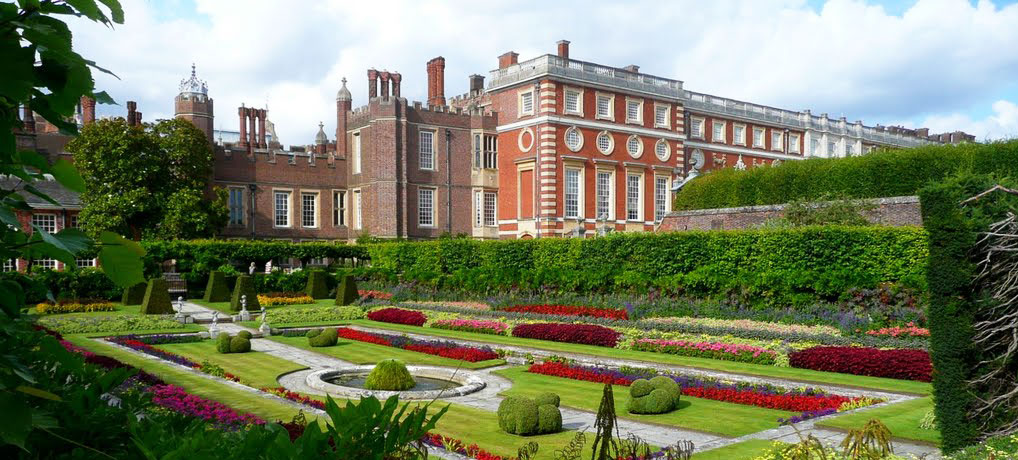
The palace’s formal gardens, the Great Fountain Garden and the Privy Garden, sit between the palace and the park. Home Park begins where they end.
Opening times and entry
- April to September: 7am to 8pm
- October to March: 7am to 6.30pm
Entry is free, and you don’t need a palace ticket. Parts of the park are closed at times for events, above all in early July, when the RHS Garden Festival takes over a large area. Fires and barbecues are banned everywhere in Home Park and along the riverside Barge Walk. Check the official Home Park page before you go.
A royal hunting park
Cardinal Wolsey enclosed the land when he built Hampton Court in the 1510s and 1520s, walling in about 2,000 acres that became Home Park and Bushy Park. When Henry VIII took over the palace, he turned the parks into hunting grounds, stocked with deer and game. Henry was a passionate hunter, and the parks gave him sport within a short ride of his rooms.
Later monarchs reshaped the park. Charles II added the Long Water and the first great avenues of lime trees in the 1660s. William III, who rebuilt the palace with Christopher Wren in the 1690s, extended them, so that three avenues fan out from the palace’s east front in a “goose foot”: one towards Kingston, one towards Thames Ditton and one, with the Long Water, straight down the middle. The park has been open to the public since 1894.
The Long Water
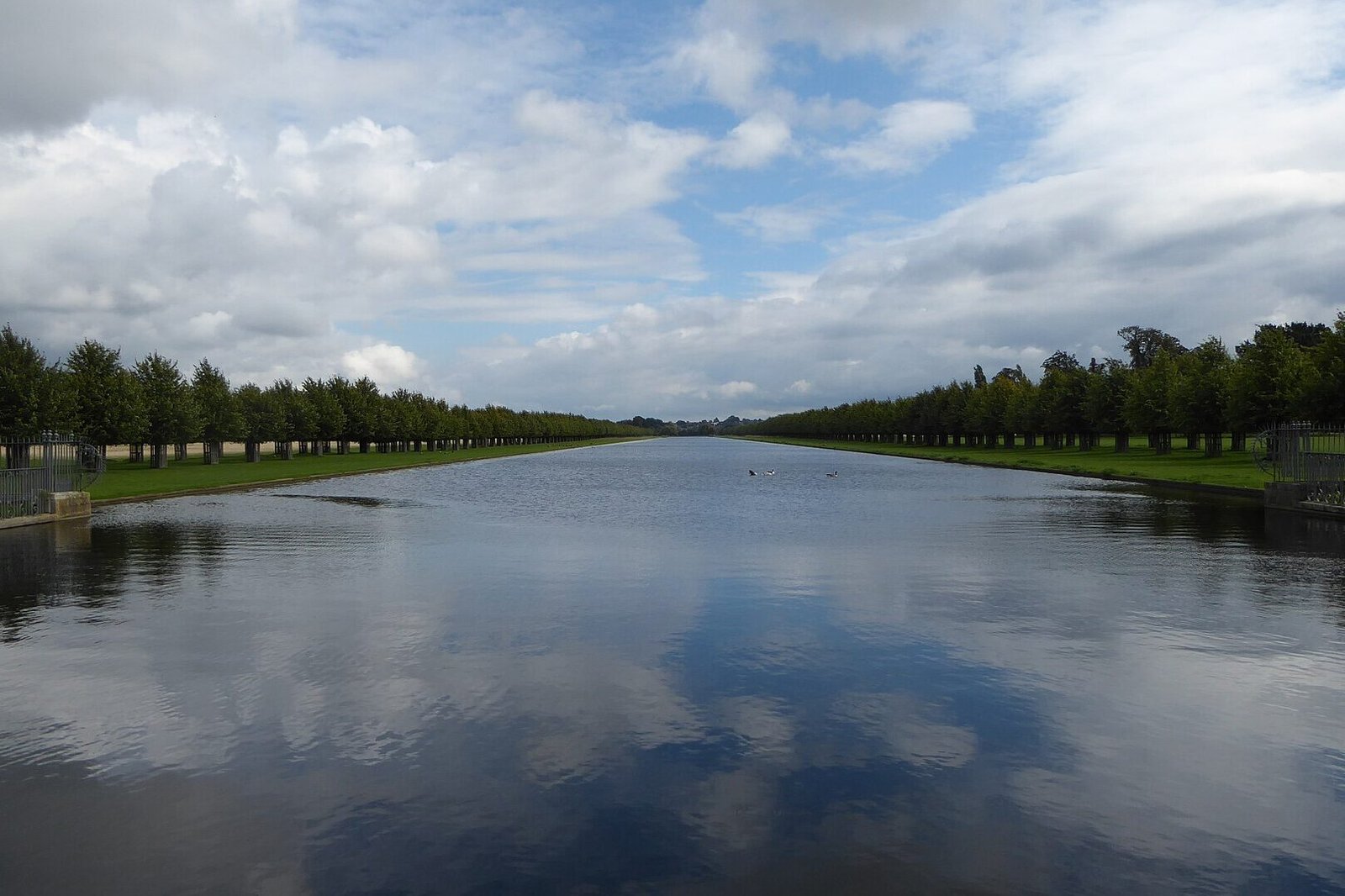
The Long Water is the park’s centrepiece: a straight ornamental canal, about three-quarters of a mile long, running east from the palace between rows of lime trees. Charles II had it dug in the 1660s, inspired by the canals he’d seen in France and the Netherlands, and it was finished around the time of his marriage to Catherine of Braganza. William III later gave it a curved extension at the palace end.
Walk to the far end and turn round for the classic view: the canal running straight back to Wren’s east front, with the fountains of the Great Fountain Garden in between. The water is fed from the Longford River, an artificial river dug for Charles I to bring water to the palace from the River Colne. Swans, coots and herons are almost always about.
The deer
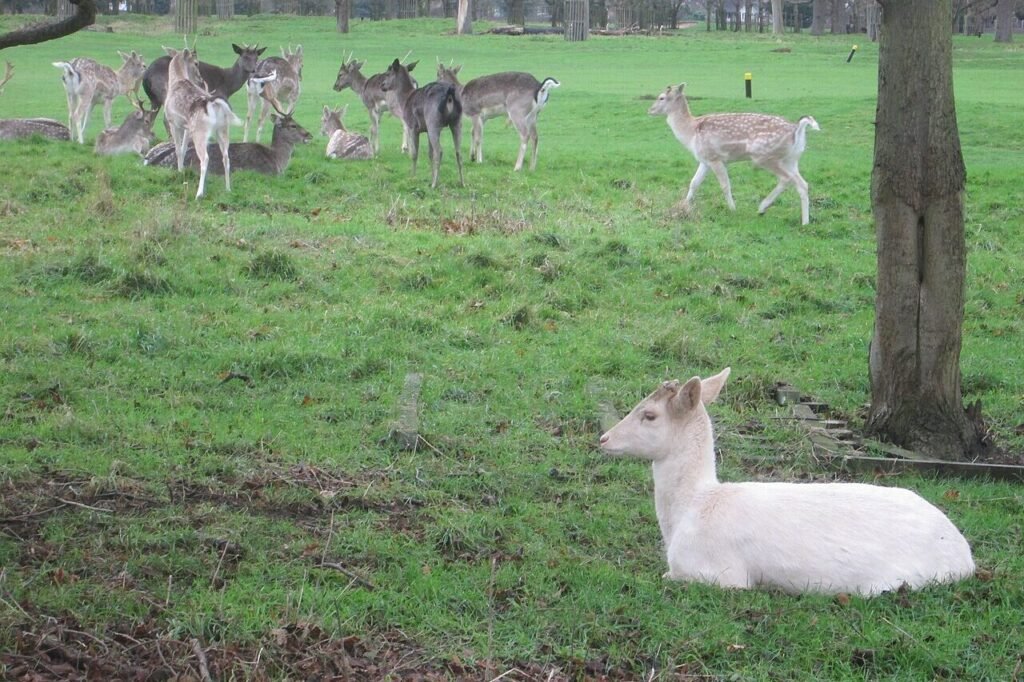
Home Park has a herd of fallow deer, descendants of the herds kept for royal hunting. They roam freely across the park and are usually easy to find, grazing in the open grassland or resting under the trees. In autumn, during the rut, the bucks bellow and fight, and in early summer the does give birth and hide their fawns in the long grass.
The deer are wild animals, and the park’s rules are strict:
- Keep at least 50 metres away from the deer, and never feed them.
- Never touch a fawn, even if it seems to be alone. Its mother will be grazing nearby.
- Stay on mown paths and out of long grass, which also protects ground-nesting birds such as skylarks.
Trees, grassland and wildlife
Home Park is a Site of Special Scientific Interest for good reason. Its acid grassland is a rare survivor of the habitat that once covered the gravel terraces of the Thames valley, and it supports plants that are now scarce in south-east England. Its veteran trees, mostly limes, along with ancient oaks, are full of dead wood that is home to rare beetles and other insects. One huge oak near the golf course is thought to be many centuries old.
Keep an eye out for skylarks singing over the grassland in spring, green woodpeckers, kestrels hovering over the long grass, and parakeets in the trees.
Walks in Home Park
- The Long Water and back (about 1 hour). Walk out along one side of the Long Water and back along the other for the best views of the palace. Look for deer in the open ground to either side.
- The Barge Walk (1 to 2 hours). The Thames Path follows the river round the edge of Home Park between Hampton Court Bridge and Kingston Bridge, with the park on one side and the river on the other. Walk it one way and catch a bus or train back.
- A loop from Kingston. Enter from the Hampton Wick side near Kingston Bridge and walk the avenue towards the palace, returning along the river.
The park is flat and the main paths are firm, so it suits pushchairs and most wheelchairs in dry weather. There are few facilities out in the park, so bring water, and eat at the palace cafés or in East Molesey afterwards. To see more of the area on two wheels, a guided bike tour of Hampton Court covers the palace grounds and the parks.
Home Park or Bushy Park?
The two are easily confused. Both were part of Wolsey’s and Henry VIII’s hunting grounds and both have deer, but they are separate parks on either side of Hampton Court Road.
| Home Park | Bushy Park | |
|---|---|---|
| Where | East of the palace, inside the Thames loop | North of Hampton Court Road |
| Size | About 750 acres | About 1,100 acres |
| Run by | Historic Royal Palaces | The Royal Parks |
| Famous for | The Long Water and the view of the palace | Chestnut Avenue and the Diana Fountain |
| Opening times | Daytime hours (see above) | Open 24 hours to pedestrians for most of the year, with shorter hours during deer management periods |
Getting there and parking
Home Park is a short walk from Hampton Court station, which has trains from London Waterloo every 30 minutes. Cross the bridge, walk past the palace’s main gates, and follow the signs. From Kingston, walk over Kingston Bridge and enter from the Hampton Wick side. There is parking at the palace. See our guide to getting to Hampton Court for trains, boats, buses and car park charges.
Make a day of it: walk in the park in the morning, then visit the palace and the maze in the afternoon. The formal gardens are next door.
Questions people ask
Is Home Park at Hampton Court free?
Yes. Home Park is free to enter and doesn’t need a palace ticket.
What time does Home Park close?
At 8pm from April to September and 6.30pm from October to March. It opens at 7am all year.
Can you see deer in Home Park?
Yes. A herd of fallow deer roams the park and is usually easy to spot. Keep at least 50 metres away.
Are dogs allowed in Home Park?
Yes, but they must be under close control at all times, and on a lead everywhere in the park from 1 May to 31 July, when the deer are giving birth.
Is the RHS Hampton Court flower show in Home Park?
Yes. The RHS Hampton Court Palace Garden Festival is held in Home Park every July. Part of the park is closed while it is set up, held and taken down.
Some links on this page earn us a commission at no extra cost to you. How this site makes money