The Hampton Court maze: history, tips and how to reach the centre
Planted for William III around 1690, Britain’s oldest hedge maze has been losing visitors for three centuries. Its story, and how to reach the centre.
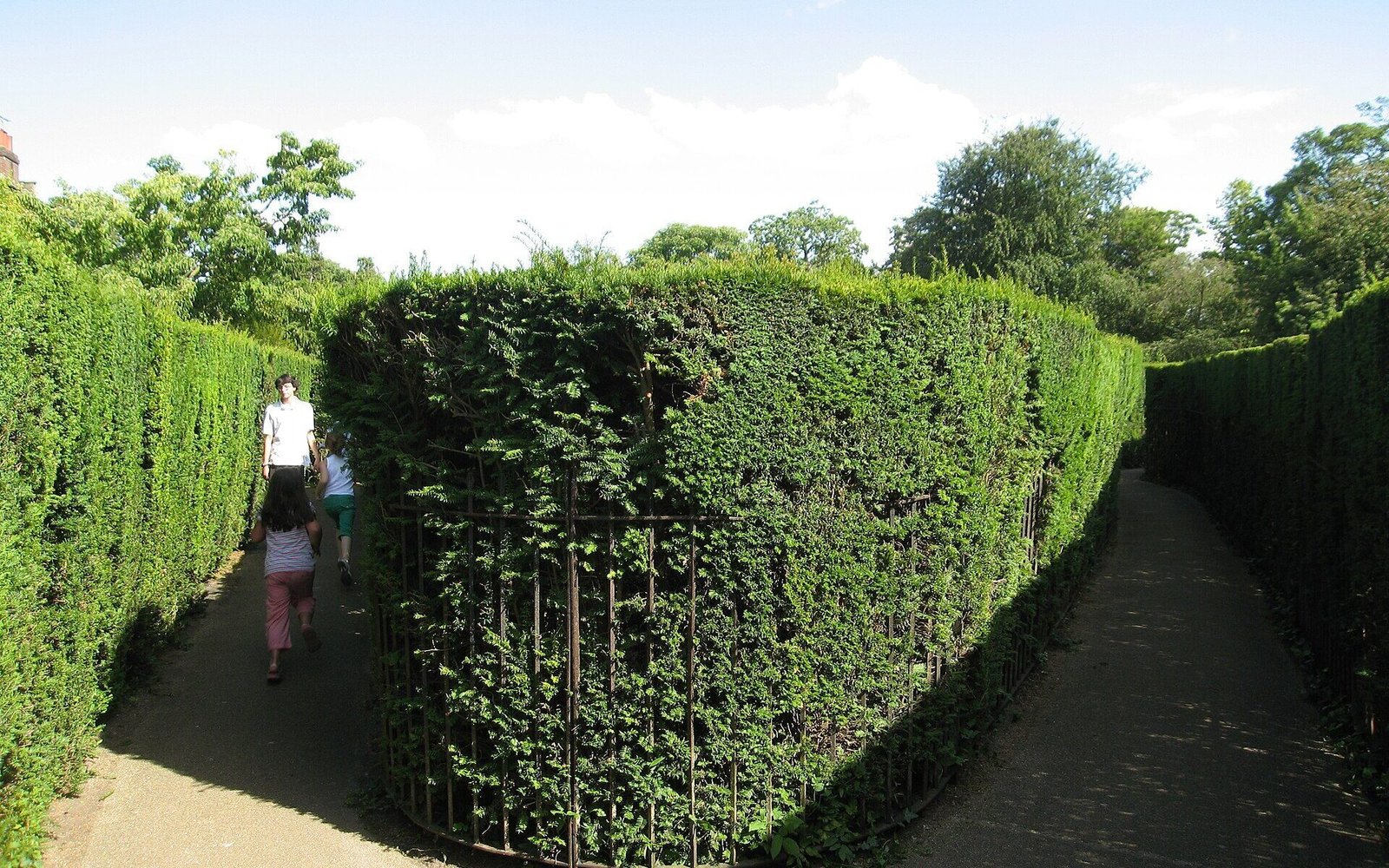
Of all the things to do at Hampton Court, the maze is the one people remember. It’s been confusing visitors since the 1690s. It is Britain’s oldest surviving hedge maze, and it has inspired novels, puzzles and mathematical papers. It covers only about a third of an acre, yet it hides half a mile of paths behind hedges taller than most adults. Here’s its story, and how to find your way to the middle.
A maze for a king
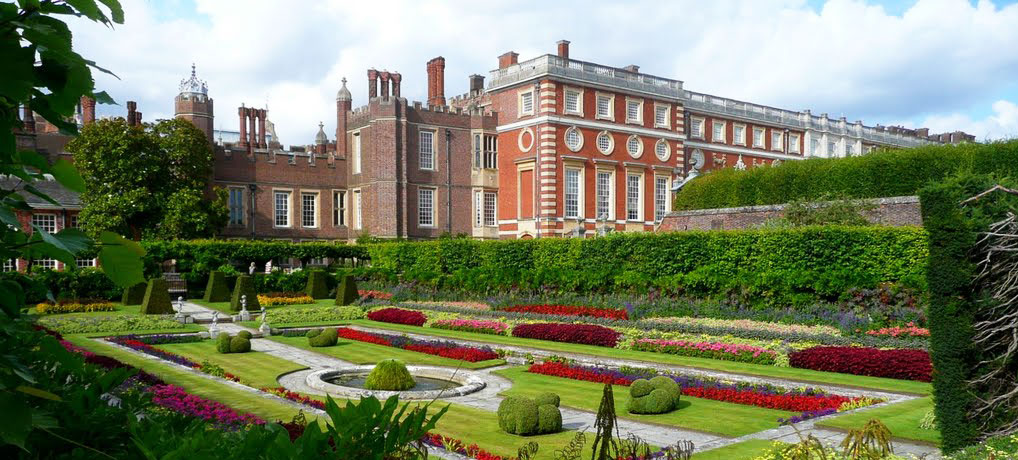
When William III and Mary II took the throne in 1689, they set out to turn Henry VIII’s rambling Tudor palace into a rival to Versailles. Christopher Wren rebuilt the state apartments, and the gardens were remodelled on a grand scale. To the north of the palace the royal gardeners George London and Henry Wise laid out the Wilderness. This was not a wild place at all but a formal garden of hedged walks and groves. Its showpiece was a puzzle maze, planted around 1690.
Hedge mazes were fashionable in Europe, but most English examples vanished when tastes turned to open, natural landscapes in the eighteenth century. Hampton Court’s survived, which is why it is now the oldest surviving hedge maze in Britain. It was originally planted with hornbeam. Over the years it was patched and then replanted with yew, which is evergreen and denser, and the palace’s gardeners have since experimented with bringing hornbeam back.
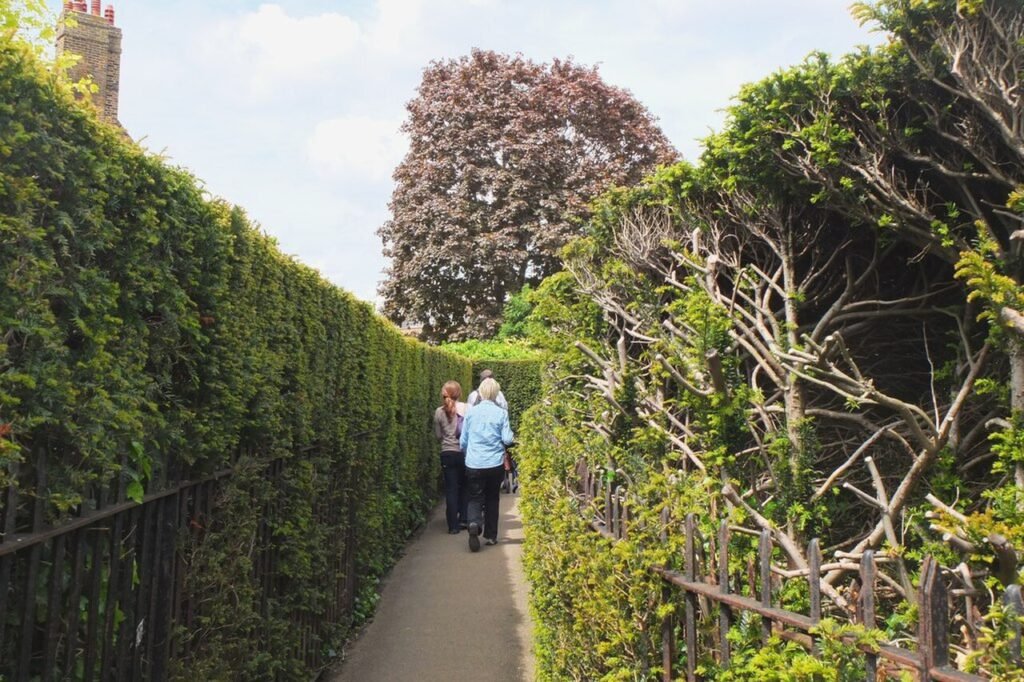
The Wilderness itself is worth a wander. Today it’s a quieter, shadier part of the gardens, planted with trees and spring bulbs, and in April and May it’s carpeted with daffodils and blossom. It lies between the palace and the Lion Gate, so if you arrive from Bushy Park it’s the first part of the gardens you’ll see.
How the maze works
The maze is a trapezoid, wider at one end than the other. It is a “multicursal” puzzle maze: unlike an ancient labyrinth with one winding path, it has real choices, dead ends and loops. At its heart is a small clearing, a welcome sight after a few wrong turns.
What makes it work is its scale. The hedges are high enough to hide the route but not so high that you lose the sky. The paths add up to about half a mile, and with all the doubling back you’ll walk much further than that. Most people reach the middle in 20 to 45 minutes. Children often get there before their parents, which is half the fun.
How to reach the centre
If you want to work it out yourself, stop reading here. If you’d like a strategy, try these, from gentlest to most foolproof:
- Look for the shape. The centre lies roughly in the middle of the trapezoid, but the paths approach it indirectly. If a corridor seems to lead straight towards the middle, it’s probably a trap.
- Remember your dead ends. Agree on landmarks with your group, such as a gap in the hedge or a bend you’ve passed twice, so you don’t repeat the same mistakes.
- Keep one hand on the hedge. The classic method is to put your right hand on the hedge as you enter and never let go. You will walk into dead ends and come straight back out, but at Hampton Court this rule will eventually take you to the centre. Puzzle fans often point out that it works here even though it fails in many other mazes.
What doesn’t work is the method used by Harris in Three Men in a Boat, who confidently tells everyone to keep taking the first turning to the right.
The maze in books
The maze’s most famous appearance is in Jerome K. Jerome’s comic novel Three Men in a Boat (1889). Harris, sure of himself, says he’ll show a cousin round the maze and explains that it is very simple: you just keep taking the first turning to the right. He picks up a growing crowd of lost visitors who follow him trustingly, and leads them round and round until everyone ends up back where they started. Eventually they are rescued by a keeper, who then gets lost himself. It’s the best-known scene in the book and still funny today, and the maze is a regular stop for fans retracing the three men’s route along the Thames.
The maze has also fascinated mathematicians. Its layout appears in Victorian and Edwardian puzzle books, including Henry Dudeney’s Amusements in Mathematics (1917). It’s still used to teach the logic of mazes, from hand-on-the-wall rules to the algorithms that guide robots and computer games.
The maze and the Victorian day-trippers
For its first 150 years the maze was a private amusement for the court. That changed in 1838, when the young Queen Victoria opened Hampton Court’s state apartments and gardens to the public, free of charge. The railway reached Hampton Court in 1849, and soon Londoners were coming out by the trainload on summer weekends. The maze became one of the great popular attractions of Victorian London. Visitors in their Sunday best shouted to each other over the hedges, and keepers were on hand to rescue anyone who was hopelessly lost.
That is the world Jerome K. Jerome was writing about. When his three men row up the Thames in 1889, a visit to Hampton Court and a go at the maze is exactly what any day-tripper would do. The tradition has never really stopped: today the maze welcomes hundreds of thousands of visitors a year, and it still produces the same mix of laughter, mild arguments and triumphant cheers from the centre.
The maze with children
For families, the maze is often the highlight of the day. A few tips:
- Give older children the lead. Let them navigate while you follow, and agree that everyone stays within shouting distance.
- Agree a meeting point. The centre is the obvious one, and if anyone gets separated the hedges make it hard to spot them.
- Make it a race. Split into two teams, one using the right-hand rule and one trusting its instincts, and see who gets there first.
- Read the book first. The maze chapter of Three Men in a Boat is short, very funny, and makes a good story to read aloud on the train.
Visiting the maze
The maze is in the Wilderness, a short walk north of the palace towards the Lion Gate. It is included in a standard palace ticket. See our guide to Hampton Court tickets for prices and ways to save. Last entry to the maze is usually shortly before the palace closes, so if you’re short of time, do the maze first and the state apartments after.
- Best time: first thing in the morning or late in the afternoon, when the school groups have gone.
- Nearby: the formal gardens, the Magic Garden adventure playground (open in the warmer months) and the Tiltyard Café.
- Free days: the maze is not included on the palace’s free gardens open days. You still need a ticket.
If you’re visiting with children, combine the maze with the Magic Garden and the Tudor kitchens and you have a full day out. For something completely different afterwards, take a guided bike ride along the Thames.
Visiting with children? The Magic Garden, a short walk away, is included in the same ticket.
Questions people ask
How old is the Hampton Court maze?
It was planted around 1690 for William III, which makes it more than 330 years old and the oldest surviving hedge maze in Britain.
How long does the Hampton Court maze take?
Most visitors reach the centre in 20 to 45 minutes. With the right-hand rule it takes longer but always works.
Can you visit the maze without a palace ticket?
On most days you need a palace ticket, which includes the maze. Maze entry is not included on the free gardens open days.
How big is the Hampton Court maze?
It covers about a third of an acre, with roughly half a mile of paths between hedges that are taller than an adult.
What is the trick to the Hampton Court maze?
Keep your right hand on the hedge from the moment you enter, and don’t let go. It isn’t the quickest route, but it will get you to the centre.
The maze is just one part of the palace’s gardens. Read about the gardens and parks, plan the journey with our travel guide, or meet William and Mary, the monarchs who commissioned it.
Some links on this page earn us a commission at no extra cost to you. How this site makes money